
Blogs
An Inquiry into Why Militaries are Terrible at Innovation (Part 1 of 5)
by : Ben ZweibelsonOriginal post can be found here: https://benzweibelson.medium.com/an-inquiry-into-why-militaries-are-terrible-at-innovation-part-1-of-5-c6f04b35fce8
Militaries perpetually call for innovation, creativity in warfare, and the need for an organization to be as nimble and flexible cognitively as they might be operationally when tangled in conflict with a cunning, learning adversary. Yet paradoxically to these aspirations, modern armed forces are continuously chastised for our lack of imagination, inability to shake institutional beliefs that are obsolete or irrelevant, and graveyards are filled with the corpses of military heretics and visionaries that were ignored, marginalized, or eliminated because they dared offer novelty that was alien and disruptive. Modern militaries need innovative thinking, yet want that innovation to unfold in a predictable, orderly, easily managed mode of development. This simply is not how innovation occurs and presents a profound tension in how modern military institutions prefer regularity and order at the expense of uncertainty and disruption that represent necessary risks for bringing forward what is needed but does not yet exist.
Indeed, institutions fail to imagine that which is needed tomorrow due to such novelty in warfare unfolding in unfamiliar, ill-described, and confusing packaging. Yet we still insist on trying to improve our ability to innovate so that we might gain novel advantages unimagined by competitors and adversaries. Often, we fixate and obsess on technical and tactical innovation while expecting such local or immediate developments to suffice for overarching, strategic and game-changing transformations. Militaries fail to see the forest for the trees. More often than not, modern militaries remain well stocked with careerists and leadership that attempt to introduce and use ideas and terms such as ‘disruption’, ‘innovation’, ‘creativity’, and a host of other concepts oriented toward imagination and change, but sadly “the rhetoric is simply camouflage designed to deflect attention from use of managerial practices and technology that disappeared decades ago in civilian life”[1] Our militaries exist in a complex, dynamic reality [2] but continue to orient to the past through a Newtonian styled, factory-management themed worldview for how one must approach innovation and transformation. We want to win, but only in familiar ways that reinforce our service identities and particular forms and functions as warfighters. Innovation is welcome as long as it extends what worked yesterday, which means that hardly anything innovative is allowed in, and obsolete practices are extended well beyond their shelf lives.
Contemporary military theory and methods seek ways to innovate in warfare so that the military organization creates novel, unimagined opportunities that their adversaries have not. This is important, necessary, and whether one invents the necessary change or one is dragged there by a cunning adversary through defeat and disruption, such innovation always occurs in war. However, militaries that unwittingly adhere to their particular war paradigm are institutionalized into rejecting many acts of innovation that are not immediately recognizable and able to integrate seamlessly with existing legacy constructs. Instead, in often a blatant showing of anti-intellectualism for any war theory outside the approved, organizationally relevant war paradigm in practice, militaries also show outright hostility and contempt for creative war thinking that threatens disruption, change, and painful introspection. This is a damning statement, but one that is fairly easy to demonstrate repeatedly across military services through how methods, doctrine, and belief systems demand orthodoxy and adherence to the institutional framework above all else. Gharajedaghi, addressing modern society writ large and this bias toward retaining institutionalized beliefs and patterns of self-relevant behaviors despite their increasing irrelevance in emergent system change offers: “The inability to change and outdated mode of organization is as tragic for the viability of a corporation as the consequence of missing a technological break is for the viability of a product line.”[3] This preference to resist the novel and alien so that the familiar and favored is retained stems from a fundamental mischaracterization of innovation, in that modern militaries assume all aspects of complex warfare can only be interpreted through a rationalized, natural science lens that reverse-engineers warfare analytically.[4]
Karl Weick, a noted sociologist and organizational theorist, provides one useful explanation of how humans imagine, create, and also conform to organizational frames. All innovation is accomplished through human imagination, in that “imagination gives form to unknown things.”[5] Harari, in explaining the rise to dominance of the human species, provides useful context in how humans can conceptualize that which does not exist in the real world. While this first step occurs in a single mind, humans then employ narratives to convey these fantastic ideas to convince others about things that they themselves had not yet imagined either:
Telling effective stories is not easy. The difficulty lies not in telling the story, but in convincing everyone else to believe in it. Much of history revolves around this question: how does one convince millions of people to believe particular stories about gods, or nations, or limited liability companies? Yet when it succeeds, it gives Sapiens immense power, because it enables millions of strangers to cooperate and work towards common goals. Just try to imagine how difficult it would have been to create states, or churches, or legal systems if we could speak only about things that really exist, such as rivers, trees and lions.[6]
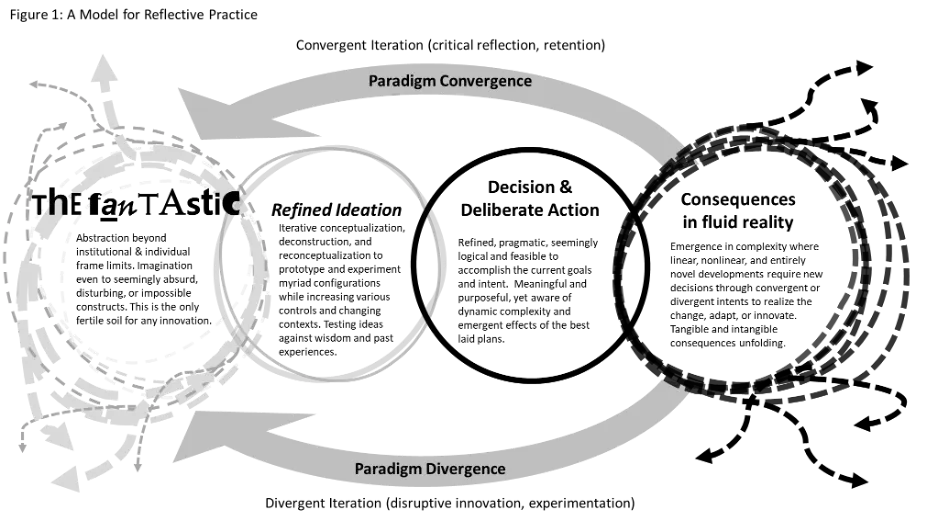
Imagination sparks the development of the unimaginable into the realized and useful; this is the only way that invention occurs. Invention itself is the tangible act of humans realizing the intangible in a novel, previously unrealized way so that new opportunities and consequences occur in this deliberate creation, to include many subsequent ripples that the creator could not foresee. In these moments of innovation, the creator lacks terminology, and may need to also craft entirely new conceptual models, perhaps modify or generate new theories, so that the invention gains some form that can be shared and understood by those unfamiliar (and surprised) by the change. Every act of military innovation requires this, and with the ushering in of the unrealized and unprecedented, the military institution tends to resist it because of these surprising qualities. It is not only that new things require new names, but invention destroys before it creates. The act of innovation starts with a fantastical leap into the unknown because the current system is insufficient or faulty in such that a creative act is warranted. We create because the legacy frame must in some small or great way be destroyed.
Institutions do not willingly operate through destructive and disruptive activities if they challenge the very constructs that sustain the organizational identity, beliefs, and known patterns of behaviors. This is why innovation cannot be manufactured or built into existing institutional processes that require convergence, uniformity, reliability, predictability, stability, order, and conformity. Military doctrinal publications are indeed the last place where innovation might be found, in that any novelty or disruptive innovation that might occur will be assimilated and stripped down so that it can only integrate with the pre-existing, legacy frame championed by the military institution producing said doctrine. While critical and creative thinking are mentioned within such managerial decision-making methodologies found in doctrine, militaries cannot allow such activities to threaten the core belief systems or venture past clear paradigmatic boundaries imposed by the institution. One must be critical and creative only so that new coloring might occur within the predetermined lines set by the dominant war paradigm.
These qualities maintain an institution and extend bureaucratic effects so that they manifest across all participants. Effective organizations tend be adaptive instead of innovative, in that the innovation is done in the fringes and peripheries of how an organization functions. Once innovation is realized, the bureaucratic entity adapts it through assimilation, often while experiencing damage or losses due to the legacy practices advocated by the institution failing in new ways due to how the innovation disrupts or changes the system. Militaries maintain institutional control and stability through convergent doctrinal processes with an epistemological position that “anything new must be clearly understood by the entirety of the force in recognized language, and easily validated through established practices so that immediate advantage can be gained in a reliable, risk-reducing mode of execution.” This presents a convergence of deductive and inductive logics on how innovation ought to occur so that the institution experiences incremental process improvement, and not radical, surprising, and transformative change. Brown, a security theorist, provides a blistering critique of the modern military culture as demonstrated in the Pentagon where the entire institution remains wedded in the past, while rejecting any call to transform and discard outdated theories, beliefs, and concepts that are now ritualized into institutional identity:
[Within the Pentagon and Department of Defense culture], stolid managerialism is the default, and people are too often treated as interchangeable widgets in an immense industrial machine. Founded on a doctrine of hierarchical control informed by both the military traditions and the pseudo-scientific management theories of the 19th century, it has elevated conformity to virtue and excels at stifling dissent; initiative and creativity are just collateral damage. Information flows up — or is “staffed” in defense parlance — and power trickles back down. Important leaders choose less important leaders; everyone else competes within the rigid confines of a civil service system that we’ve known to be fundamentally broken for decades. Compensation is commensurate with status and tenure, not talent or contribution. Tasks are assigned, performance is evaluated, rules are promulgated — forming the basis of a culture of risk aversion that makes the faithful maintenance of the status quo a much safer bet than attempting to challenge it. Pentagon reporter Jeff Schogol perhaps put it best when he compared the Defense Department to a “Sears mail-in catalogue that is struggling to stay relevant in an Amazon Prime world.”[7]
This modern military frame is an extension of one crafted largely in the eighteenth and nineteenth centuries, through a fusion of Napoleonic War theorizations, the consequences of the rise of Westphalian nation states, and the adaptation of Newtonian styled scientific logic to explain war in objective, predictive, and largely mechanistic terms. Management of war would become factory-like, built within the Industrial Revolution and oriented toward increasing efficiencies, uniformity, and process adherence. Gharajedaghi, a complexity theorist, provides an excellent rebuke of this Newtonian styled epistemology on how innovation unfolds. Complex reality does not function this way, as such Newtonian orientation can only exist in simple or at most, some complicated system conditions.[8] Innovation occurs in surprising, often confusing ways, where at first, an organization may only have glimmers of the opportunity, and those that realize it may struggle with dense theory and require new words and models to develop it. Over time, an organization experiments and develops this innovation, gradually refining and maturing it, so that the last step for institutional change is one where the entire organization gains some common understanding or framing. This inverts the modern military paradigm, in that common understanding across the entire enterprise becomes the last, not the first step. Gharajedaghi summarizes the absurdity of forcing all innovation to first clear the bar with new learning being immediately understood across the largest population with: “I assure you that we will fast fall to the lowest level of banality. Life would proceed with setting and seeking attainable goals that would rarely escape the limits of the familiar.”[9] Modern military fixation on oversimplification of all novelty extends from earlier periods of factory-styled order and discipline, and likely a paradigmatic lack of awareness of how strong this Newtonian stylization grips the force.[10]
Weick offers an important distinction in how organizations resist innovation and instead encourage a self-serving, institutionally relevant mode of creation. Citing Coleridge, Weick explains that “fancy” operates in a mode where the institution insists on recombining known things and concepts in institutionally recognizable ways, compliant and orthodox to extending that institutional paradigm from yesterday to tomorrow.[11] Weick uses the mythical creature ‘Pegasus’ to illustrate. Pegasus is a static combination of two known ideas, ‘wings’ and ‘horse.’ The concepts are already well understood by the institution, and “neither idea changes nor interacts with the other. They are simply stuck together.”[12]
When organizations prefer fanciful thinking to innovation, they are defaulting to an institutionally self-relevant mode of extending yesterday’s favored concepts into an uncharted tomorrow, assuming along the way that solutions proven trace straight lines to the next ill-defined problems. Dorst explains this static, linear interpretation of a complex reality with: “conventional problem-solving requires us to stop the world, isolate the problem, and come up with a one-off solution… This approach is curiously nonexperimental… All organizations will initially try to approach a new problem in ways that have worked in the past.”[13] Weick reinforces this organizational habit with: “When people settle for fancy, the problem is that their choice of current frames is too dependent on frames previously used.”[14] Advocates of modern military doctrine tend to miss this distinction in that they are convinced that fanciful content is innovative when it merely recycles approved institutionalized forms into different combinations. While it may barely qualify for innovation, anything beyond this automatically becomes too disruptive to ever include into military doctrine without breaking the mold. Thus, all innovation occurs in the peripheries and margins of a military enterprise, often pursued by mavericks, heretics, and improvisationalists who refuse to conform to the existing system. Schogol, citing Kroger on the institutionalized patterns of conforming behavior in the Pentagon, illustrates how difficult it is to break from the party line:
More disturbing than the Pentagon’s antiquated information technology was Kroger’s description of meetings in the building, where subordinates are expected to keep quiet rather than ask questions. “Instead of interjecting their own questions or raising alternative points of view, they’re encouraged to ‘stay in their own lane,’” Kroger wrote. “The purpose of many of these meetings is not to make a decision, but to ‘update leaders on progress.’ There are no whiteboards, no thinking out loud, and usually no analysis. Almost everything is scripted.” In other words, the purpose of these meetings is for Pentagon leaders to let everyone know that they are handling things perfectly. Any objection to group-think is heresy because it implies subordinates might actually understand an issue better than their superiors. The meetings themselves are useless and the information could have just as easily been sent by email.[15]
Fanciful creation generates novelty in that Pegasus does not exist in nature, but this configuration is merely a realignment of known things that already do exist in reality. As illustrated above, not only is fanciful creation a standardized mode for institutional convergence across the modern armed forces, but it is also common practice to hold senior-level meetings that perpetuate the utility of Pegasus-style thinking as successful and the only option. Wings are good, horses are good, and combining wings plus horses over and over is the best and only option… or else. The institution retains both original concepts, and while Pegasus is a new naming device, the original paradigm remains unaltered in that nothing is disrupted, destroyed, or challenged in some critical manner of self-examination. As Weick offers: “[when] people engaged in fancy, they produce simple associations of adjacency rather than the compound associations of simultaneity; they link one point to another rather than form clusters of multiple links around one point; and their ideas grow incrementally rather than exponentially.” As cited above by Schogol, an institution such as the Pentagon can maintain the illusion of progress by promoting fanciful production of ‘known knowns’, with operators instructed to carry on in scripted, ritualistic fashion to tow the party line. It is this incremental manner of fanciful development that the institution seeks, so that an orderly, controlled, and linear mode of progression retains all of the institutional beliefs, patterns, and framework while the fanciful additions enhance or otherwise retain the paradigm relevance. Innovation unfolds in direct opposition of fancy, in that innovative efforts threaten the preferred illusion of order, control, and stability. This is where the heretics thrive (or are slaughtered).
[1] John Kroger, “Office Life at the Pentagon Is Disconcertingly Retrograde,” Wired, August 20, 2020, https://www.wired.com/story/opinion-office-life-at-the-pentagon-is-disconcertingly-retrograde/.
[2] Gharajedaghi, Systems Thinking: Managing Chaos and Complexity, A Platform for Designing Business Architecture, 51.Gharajedaghi offers a useful metaphoric device for appreciating dynamic, learning systems in complexity theory. “Analyzing the behavior of a nonlinear system is like walking through a maze whose walls rearrange themselves with each step you take (in other words, playing the game changes the game).” Dynamic systems are unlike simple or complicated systems where the “maze” is either fixed, or able to be predicted in likely system transformation so that useful strategies and operations might be prepared in advance.
[3] Gharajedaghi, Systems Thinking: Managing Chaos and Complexity, A Platform for Designing Business Architecture, 17.
[4] Jamshid Gharajedaghi, Systems Thinking: Managing Chaos and Complexity, A Platform for Designing Business Architecture, Third (New York: Elsevier, 2011), 13, http://pishvaee.com/wp-content/uploads/downloads/2013/07/Jamshid_Gharajedaghi_Systems_Thinking_Third_EdiBookFi.org_.pdf; Christopher Paparone, “How We Fight: A Critical Exploration of US Military Doctrine,” Organization 24, no. 4 (2017): 516–33, https://doi.org/o0r.g1/107.171/1773/5103505804814716769933853; Ben Zweibelson, “Linear and Nonlinear Thinking: Beyond Reverse-Engineering,” The Canadian Military Journal 16, no. 2 (2016): 27–35; Ben Zweibelson, “One Piece at a Time: Why Linear Planning and Institutionalisms Promote Military Campaign Failures,” Defence Studies Journal 15, no. 4 (December 14, 2015): 360–75.
[5] Karl Weick, “The Role of Imagination in the Organizing of Knowledge,” European Journal of Information Systems 15 (2006): 447.
[6] Yuval Harari, Sapiens: A Brief History of Humankind, Reprint edition (New York: Harper Prennial, 2018), 31.
[7] Zachery Brown, “The Pentagon’s Office Culture Is Stuck in 1968: The U.S. National Security Bureaucracy Needs a Severe Upgrade,” Foreign Policy, October 25, 2021, https://foreignpolicy.com/2021/10/25/pentagon-office-culture-stuck-modernize-workforce/; Jeff Schogol, “The Pentagon Is a Shrine to Antiquated Technology Where Creative Thinking Goes to Die,” Task and Purpose, August 22, 2020, https://taskandpurpose.com/news/pentagon-obsolete-technology-no-creative-thinking/. Brown cites Schogol in the above quote.
[8] Jochen Fromm, “Types and Forms of Emergence,” ArXiv: Adaptation and Self-Organizing Systems, June 13, 2005, 1–23; Haridimos Tsoukas, “Introduction: Chaos, Complexity and Organization Theory,” Organization 5, no. 3 (1998): 291–313.
[9] Gharajedaghi, Systems Thinking: Managing Chaos and Complexity, A Platform for Designing Business Architecture, 63.
[10] Stephen Waring, “Taylorism and Beyond: Bureaucracy and Its Discontents,” in Taylorism Transformed: Scientific Management Theory since 1945 (Chapel Hill, North Carolina: The University of North Carolina Press, 1991), 9–19; Paparone, “How We Fight: A Critical Exploration of US Military Doctrine”; Antoine Bousquet, “Cyberneticizing the American War Machine: Science and Computers in the Cold War,” Cold War History8, no. 1 (February 2008): 77–102.
[11] Weick, “The Role of Imagination in the Organizing of Knowledge,” 447–48.
[12] Weick, 448. Weick also cites Engell, 1981.
[13] Kees Dorst, Frame Innovation: Creating New Thinking by Design, Design Thinking, Design Theory (Cambridge, Massachusetts: MIT Press, 2015), 15.
[14] Weick, “The Role of Imagination in the Organizing of Knowledge,” 449.
[15] Schogol, “The Pentagon Is a Shrine to Antiquated Technology Where Creative Thinking Goes to Die”; Kroger, “Office Life at the Pentagon Is Disconcertingly Retrograde.” Schogol cites Kroger in this citation.